5 Reasons Sales Coaching Fails (and What High-Performing Managers Do Differently)
Most sales managers believe in coaching. Many struggle to do it consistently, and the ones who do look very different from the ones who don't.
According to Salesforce, in 2024, 67% of reps didn’t expect to hit quota, and 84% had missed it the year before. When leaders dig into why performance stalls, coaching almost always becomes part of the conversation. The managers responsible for developing those reps aren’t failing for lack of effort or intention. Ask nine out of ten why they don’t coach more and you’ll hear the same two answers: no time and no clear method. Both are true. Both are fixable.
Here are five reasons sales coaching breaks down, and what high-performing managers do differently at each one. Reason #1: Who You Coach Matters as Much as How You Coach
The most common time drain in sales coaching isn't the coaching itself; it's investing in reps who won't use it. Most organizations assume every rep deserves equal coaching attention.
That's not how development works.
Think of coaching like a rewards program. It only pays off for the reps who show up for it. A rep with the desire to improve will compound your effort. A rep who's checked out will sit through the session and change nothing. Would you invest in a stock you knew wouldn't yield a return?
ASLAN's QuadCoaching™ framework gives managers a simple lens for making that call, mapping each rep against two variables: their results and their desire to change.
Where a rep lands determines your strategy:
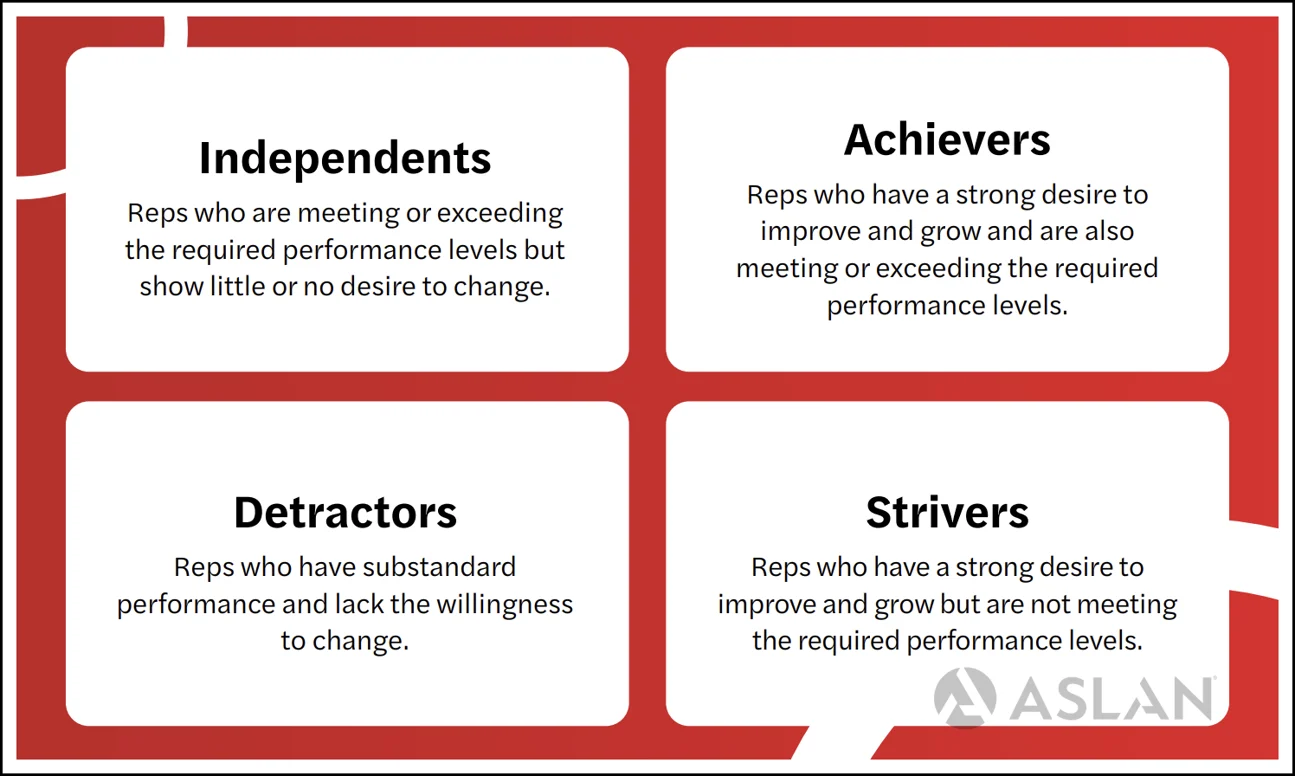
- Strivers (high desire, underperforming): Your highest coaching priority. They want to improve, so this is where your time compounds.
- Achievers (high desire, strong performers): Coach to challenge and grow. Push them or they'll find someone who will.
- Independents (low desire, strong performers): Resist the urge to coach immediately. First understand what would motivate them to grow beyond their current success.
- Detractors (low desire, underperforming): Minimal investment until desire surfaces. Set expectations, define consequences, and have the harder conversation.
When managers stop distributing their time equally and start aiming it strategically, coaching stops feeling like a drain, and starts compounding where it counts.
Reason #2: Coaching That Serves the Manager Doesn't Develop the Rep
Coaching effectiveness diminishes when it serves the coach more than the player. When a manager coaches to check a box, reinforce their own preferences, or demonstrate their expertise, the rep may sit through the session, but they won't change.
Picture two managers running a debrief after a call:
The first spends forty-five minutes walking through everything the rep did wrong relative to the company's sales methodology. The second opens with one question: "What were you trying to accomplish in that conversation, and how do you think it went?"
The first manager is coaching to their agenda. The second is coaching to the rep's. The development that happens in those two conversations is not comparable.
Real coaching starts with understanding what the rep is trying to achieve: their goals, their gaps, their version of success. What motivates one rep is irrelevant to another. A manager who doesn't know what a rep actually wants can't build a development plan that will stick.
In practice that means:
- Starting development conversations by asking what the rep wants to improve, not telling them
- Tying coaching goals to the rep's professional ambitions, not just quota attainment
- Measuring success by whether the rep is changing, not whether the manager is coaching
The Other-Centered® principle applies inside the coaching relationship just as it does in selling. When managers lead with the rep's whiteboard instead of their own, receptivity goes up, and so does development.
Reason #3: Reps Avoid Coaching Because It Feels Like Punishment, Not Investment
Coaching became something reps dread when reps start to associate it with a performance problem. After all, nobody looks forward to a recurring meeting that exists to tell them what they're doing wrong.
The thing is, that’s not coaching; it’s a performance review on a different calendar slot.
When reps experience coaching as punishment, they get defensive, managers get frustrated, and nothing changes. The sessions happen but the development doesn't.
Coaching should feel like an investment in someone's growth; a conversation a rep actually looks forward to because it makes them better at something they care about.
Three things that shift the dynamic:
- Find something working well before addressing what isn't. This signals that the session is about development, not critique.
- Keep the focus on one competency at a time. A rep who walks away with twelve things to fix works on none of them.
- Connect the coaching to what matters to the rep, not just what the manager needs to see improve.
When reps experience coaching as something genuinely for them, the dynamic changes. They stop bracing for it and start bringing their own questions. That's when development actually compounds.
Reason #4: Coach the Outcome First, the Behavior Second
To focus your coaching, start by mapping the specific capabilities that most directly drive results in your sales process. When a rep isn't hitting outcomes tied to those capabilities, that's your entry point. Then pick one (the gap that's costing you the most) and coach that.
Many managers do the opposite. They walk away from a call observation with a long list of behaviors and no clear priority. That's not a coaching plan. It's an overwhelming to-do list that stalls before it starts.
Use diagnostic questions like:
- Is the rep consistently engaging the customer early, or losing them in the opening?
- Are they asking discovery questions that surface real priorities, or staying surface level?
- Are they gaining commitment to a meaningful next step, or leaving conversations open-ended?
A sequence like this also removes the argument about style. If a rep achieves the outcome, the method is working; don't coach around it. If a player makes 97% of their free throws standing on one leg, leave the form alone. Move on to what isn't working.
When the outcome is missing, then diagnose the behavior. That keeps coaching specific and gives both manager and rep a clear, observable target.
Reason #5: A Coaching Framework Is Useless Without the Ability to Diagnose
Diagnosis is what separates managers who consistently develop reps from managers who don't. Most have a coaching process, usually a four- to six-step framework they've been given or built themselves. The problem isn't the process. It's that a framework tells a manager how to run the conversation. It doesn't tell them what's actually wrong.
Asking a manager to coach without diagnostic capability is like asking a dentist to advise on heart surgery. Sure, they're both doctors, but the competencies required are completely different. Without accurate diagnosis, even a well-run coaching conversation produces nothing. You can follow every step and still be solving the wrong problem.
The managers who develop reps consistently aren't just running more coaching sessions. They're also spending time in field observations, building specific development plans, and following up until behavior actually changes.
Research from Frank Cespedes supports why that cadence matters: managers who coach consistently are 71% more likely to be rated as highly motivating by their teams. Cadence is necessary. Diagnosis is what makes it work.
Effective diagnosis means:
- Observing reps in live customer situations, not relying on self-reporting
- Separating the symptom (missed quota, stalled deals) from the cause (specific capability gap)
- Building development plans tied to the diagnosed gap, not a generic improvement list
- Following up on the specific area coached, not moving on until the behavior changes
A process gives managers the structure to have the conversation. Diagnosis gives them something real to say.
Build a Coaching Culture That Actually Changes Performance
Sales coaching fails for predictable reasons: coaching the wrong reps, sessions built around the manager's agenda, development that feels punitive, outcomes ignored in favor of behaviors, and diagnosis that never happens. None of those are character flaws. They're structural gaps, and every one of them is fixable.
Gartner's 2025 research found that 75% of managers say their leadership programs aren't adequately preparing them for the future. The organizations that close that gap are the ones that consistently outperform.
Catalyst™ equips frontline sales leaders with the framework, diagnostic tools, and coaching cadence to make that happen. To learn more about how Catalyst can transform your team’s sales coaching culture, schedule a consultation today.


Unlock Your Team's Full Sales Potential
Questions? Watch our CEO, Tom Stanfill, address our frequently asked questions below.