From Training to Transformation: Using AI to Accelerate Impact
When it comes to training adoption, the gap between what gets delivered and what actually sticks rarely comes down to content.
It comes down to ownership.
Not because the content was weak. Because the conditions that make adoption possible were never built. At the Selling Power Sales 3.0 Summit, ASLAN VP of Training Jesse Rome made the case that closing that gap is an ownership problem. And the person responsible for fixing it is you.
Here's the framework, and how AI accelerates it at every stage, when the foundation is solid enough to support it.
Watch the 30-minute presentation below.
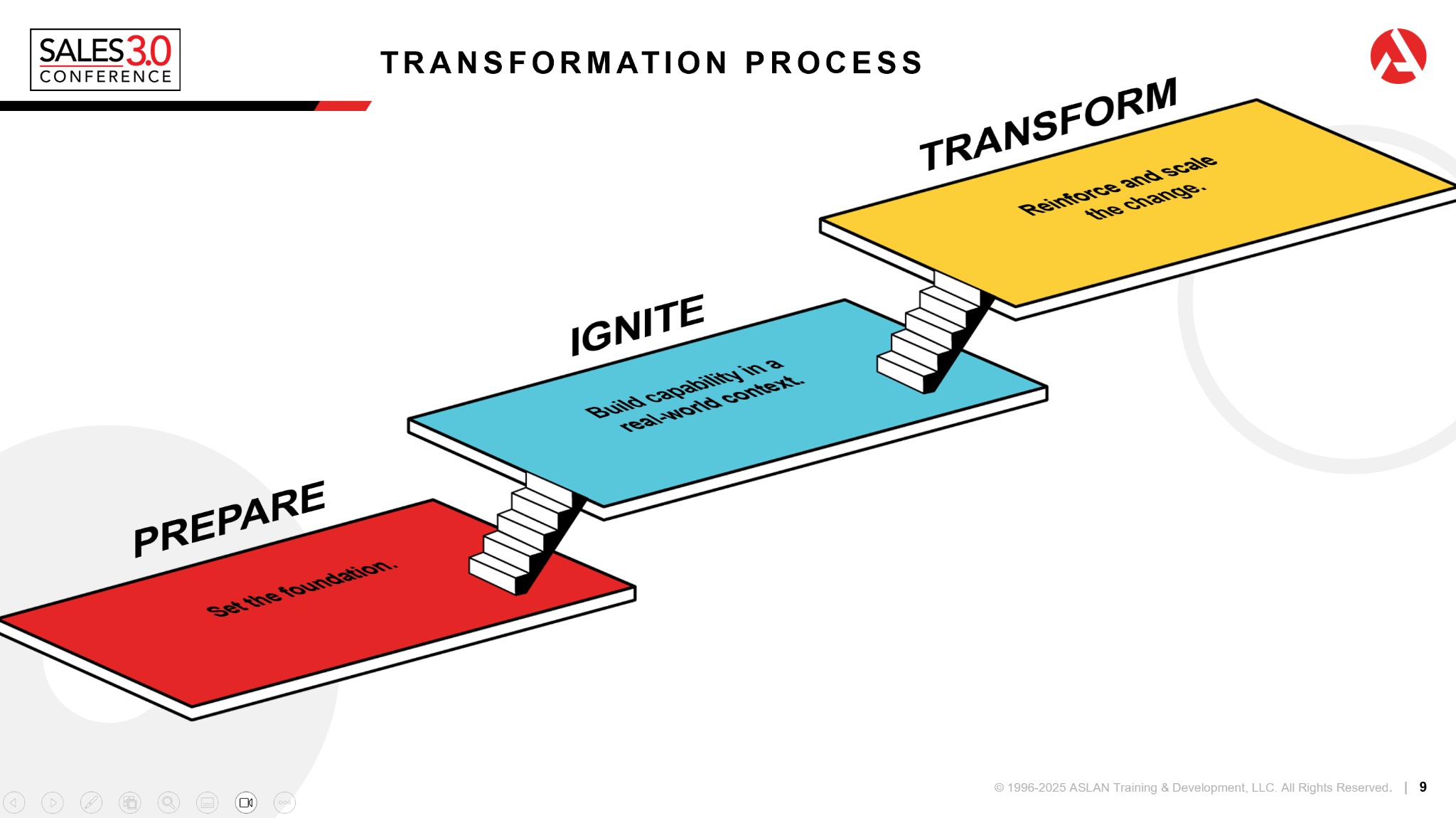
#1: Prepare: Set the Foundation Before You Build Anything
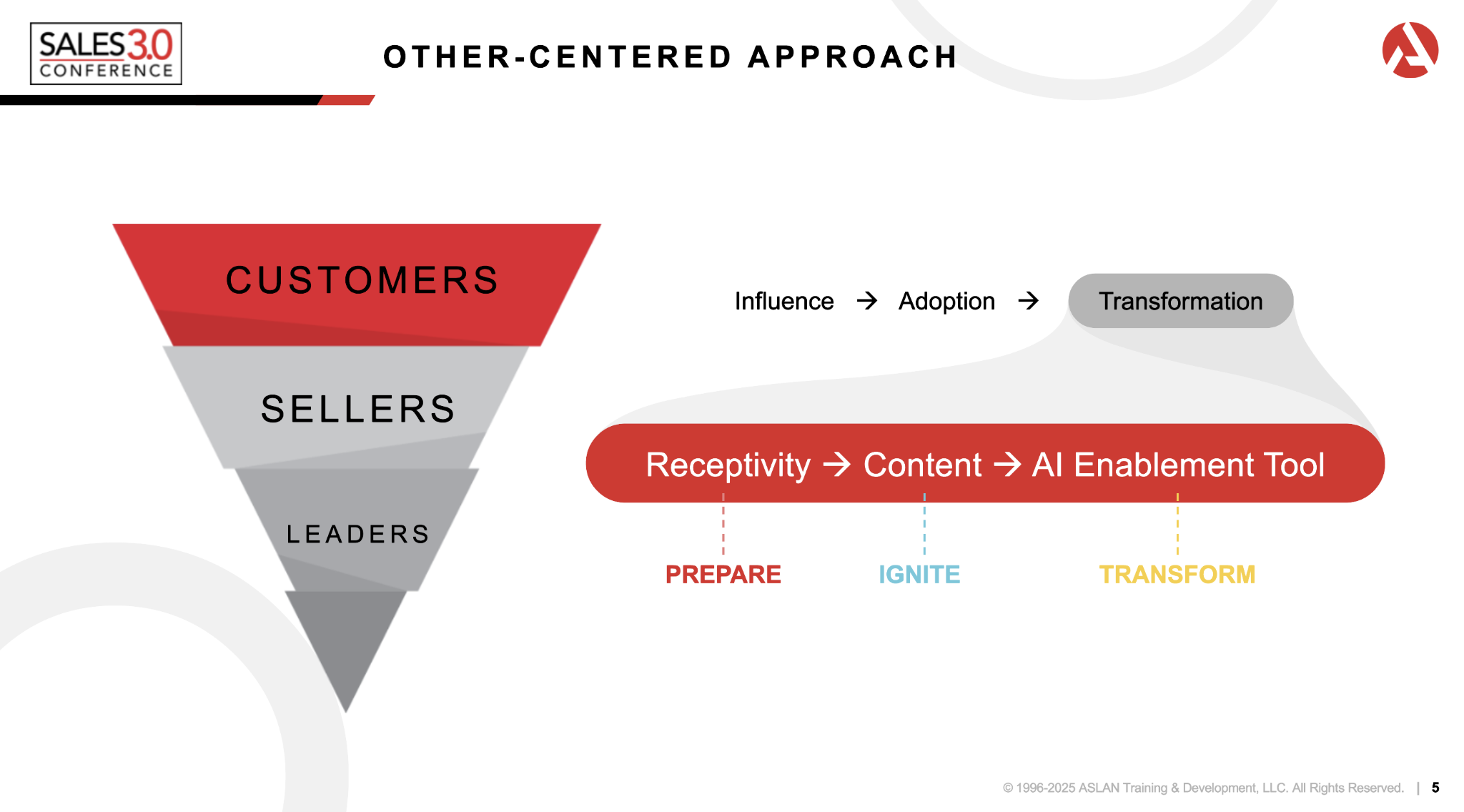
Preparation starts by flipping the pyramid.
Most organizations run top-down: leadership decides, everyone executes. ASLAN's Other-Centered® approach inverts that:
- Customers at the top
- Sellers serving customers
- Enablement leaders serving sellers.
Which means the first question before any launch isn't "what do we need to teach?" It's "what do they need to hear, and why would they care?"
Assess Before You Assume
Go to the field before you build anything. Observe people doing their actual work. Run focus groups. Use tools like GONG analytics and AI role plays to surface real capability gaps instead of relying on self-reported ones.
Why?
Objective data beats assumptions every time. It tells you exactly where to spend your limited time, and it changes how you frame the launch entirely.
If you think the tool saves time but your reps care about retaining clients, leading with efficiency loses them before the demo starts.
Align Before You Launch
Once you’ve finished your assessments, run those insights back through an alignment process before a single slide gets built. For example, have front-line rep and manager councils pressure-test your framing.
After all, executive champions will carry the message when you're not in the room. So if your leadership team sees the content for the first time at the launch, you've already missed your window.
Customize for the Audience in Front of You
If you want your content to resonate, it needs to be written for the people who need it most. Use their language, their scenarios, their customer dynamics. When people see themselves in the material, receptivity rises before you've taught a single thing.
Here’s the truth you need to remember: sales and product do not own the learner. You do. Which means the preparation work is yours to protect, even when the pressure is to skip it.
So when a sales leader pushes for a two-week turnaround, don't absorb the pressure silently. Put the trade-off on the table: "We can launch in one month and probably hit 20% adoption, or take three months and get closer to 80%. That's not a training decision; it's a business decision. What would you rather do?"
Give people choices. But don't let the decision get made without the full information only you can provide.
#2: Ignite: Launch in a Way That Earns Receptivity
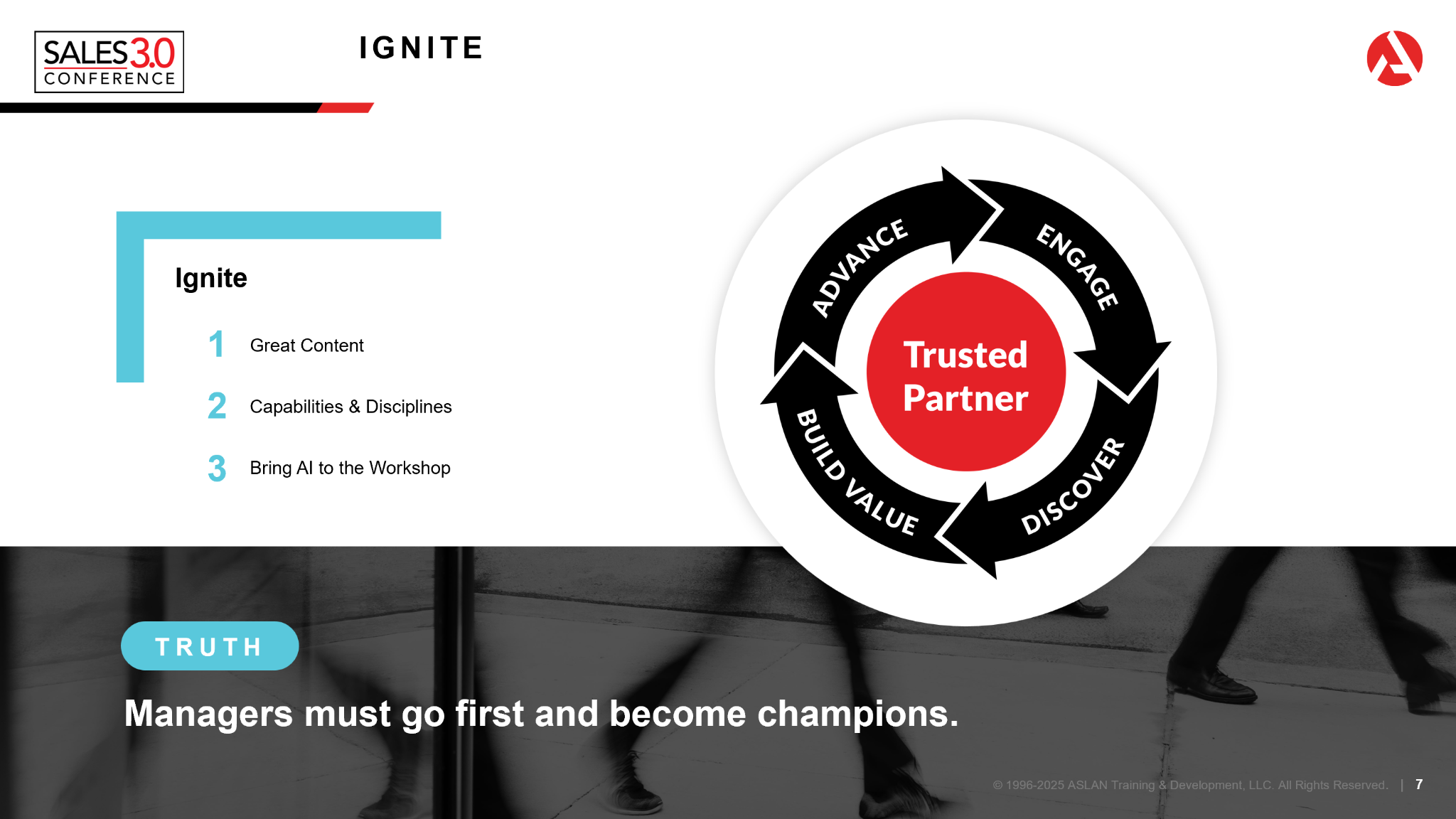
What you say doesn't matter if their ears aren't open.
Think of it as a sequence: receptivity first, then content, then the AI enablement tool. Each stage depends on the one before it. If receptivity isn't there, great content goes unheard. If the content isn't grounded in real scenarios, the tool won't get used.
The preparation work told you what's on the audience's whiteboard: their pressures, their goals, their objections. Now the content has to meet them there. The framework that drives this has three parts.
Embrace: Establish why this matters before you teach anything. Connect the training to profit or purpose; something the audience genuinely cares about. If you can't make that case clearly, you haven't earned the right to proceed.
This isn't a warm-up, it's the foundation of receptivity.
Experience: Ground the content in real scenarios with real objections and real customer conversations. Not theory. Not hypotheticals. Show people how this works in their world, in their language, against the actual resistance they face every day.
Execute: Make them practice: in the workshop, in breakout groups, through AI role play. Why? If they don't do it before they leave the room, they won't do it when they're back on the phone.
For AI tools specifically, this means getting the tool in their hands during the session, not after it. A 25-year veteran who walks in calling AI role play "witchcraft" can walk out calling it "pretty cool.” But only if they actually try it in the room, with peers present, while the energy is high.
Why Managers Must Go First
Managers are the single biggest multiplier in any training initiative, and the most consistently underprepared.
When sales reps leave a training session and go back to their teams, the manager's reaction in that first conversation shapes everything.
A manager who says "I haven't tried it yet, but it sounds promising" has quietly dismantled months of work. A manager who says "I've been using this for weeks, and I wish I had it when I was in your role" has just become the most effective adoption driver on the team.
In other words, managers can't just be the audience. They have to be the champions.
To get them on board, enable them first, not alongside everyone else. Certify them before the launch. Make them the experts in the room before the room shows up. It requires time and budget, which is exactly why it gets cut when pressure mounts. That's the moment to hold the line.
#3: Transform: Reinforce and Scale the Change
A workshop creates awareness. Transformation is what happens in the five to ten weeks after it, if the right structure is in place to sustain the change.
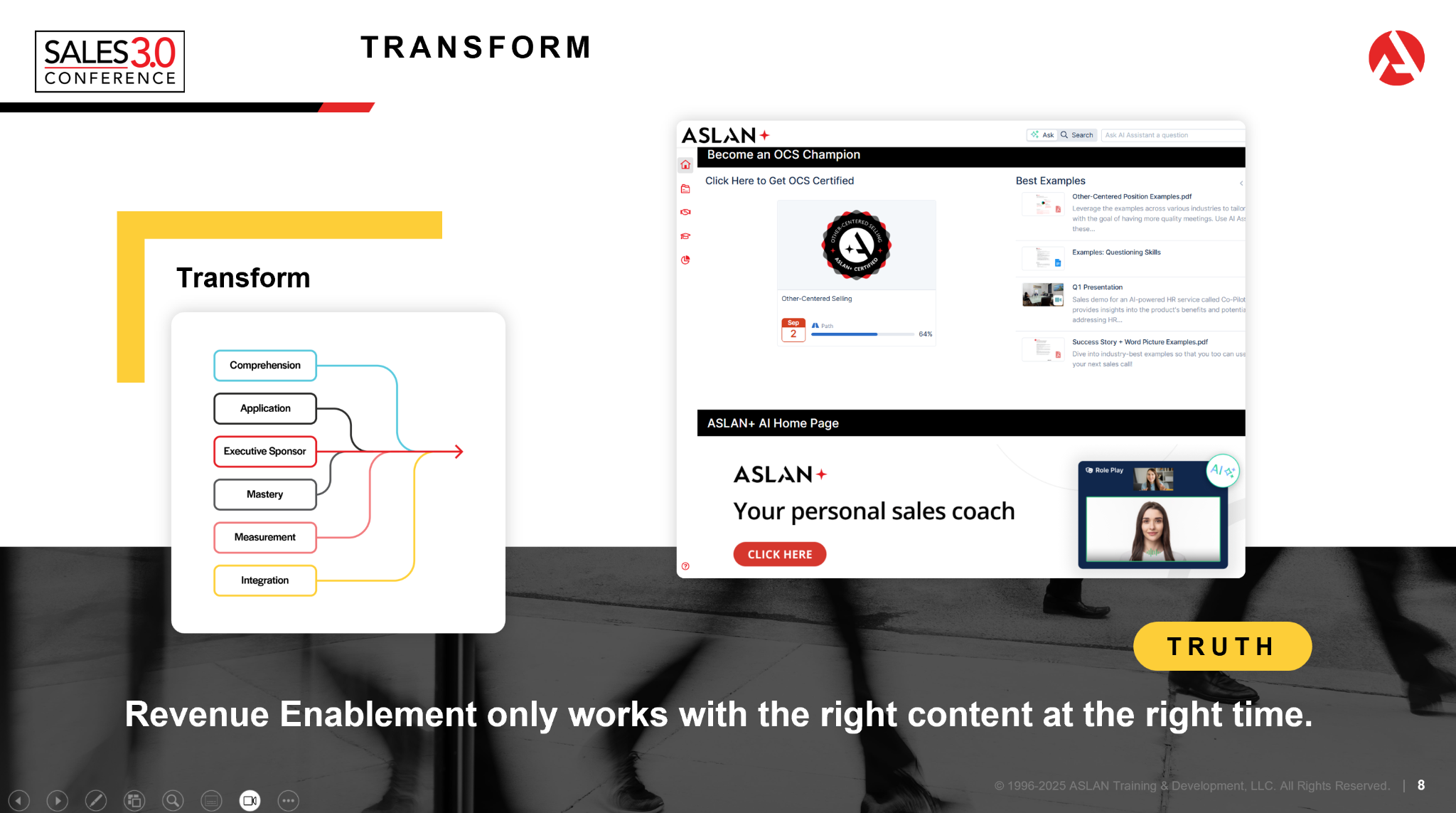
Who handles each of these is up to you. Whether you have them is not. Six requirements work together to sustain behavior change after training ends. Skip any one and the rest lose their footing.
- Comprehension: Quizzes and knowledge checks confirm reps absorbed the material. Necessary, but nowhere near sufficient . This tells you they heard it, not that they'll use it.
- Application: Training has to show up in real conversations, calls, and in real scenarios. Use AI role plays, field shadowing, and coaching to make practice trackable. Knowing it isn't the same as doing it.
- Executive sponsorship: Someone at the top has to keep beating the drum two, three months out. To make a difference, they shouldn’t frame this as another training initiative, but as a culture shift. Every organization will face the next shiny thing. Without that person holding the line, the initiative gets quietly deprioritized before the change has had time to stick.
- Mastery: Managers model what eventually becomes the team's standard. If they're not visibly using the framework, reps won't either. Certifications and defined standards give everyone a clear picture of what "good" looks like.
- Measurement: Most teams measure knowledge and call it done. But knowledge isn't adoption, and adoption isn't transformation. Benchmark KPIs like win rates, deal velocity, forecast accuracy before you launch and track what actually moved. That's what earns the seat at the table.
- Integration: If the content lives in a separate platform, reps won't use it. It has to show up where they already work, in the CRM, in call tools, accessible in thirty seconds before a customer meeting. Friction is the enemy of adoption.
Revenue enablement only works when the right content reaches the right person at the right time. These six requirements are what makes that possible at scale.
You Own the Learner. Give Them The Tools to Make It Stick.
The gap between training that's delivered and training that sticks isn't a content problem. It's an ownership problem.
Closing it means protecting the preparation work when timelines get compressed, running sessions that earn receptivity before teaching anything, enabling managers before the launch, and holding the reinforcement structure long enough for change to take hold. AI accelerates all of it, but only if someone is accountable for the foundation it runs on.
Ready to build the reinforcement structure that makes transformation stick? ASLAN+ is the enablement platform built to make all six of these requirements possible in one place. Schedule a complimentary consultation today.


Unlock Your Team's Full Sales Potential
Questions? Watch our CEO, Tom Stanfill, address our frequently asked questions below.